The Ocean is Not a Place for Oblivion
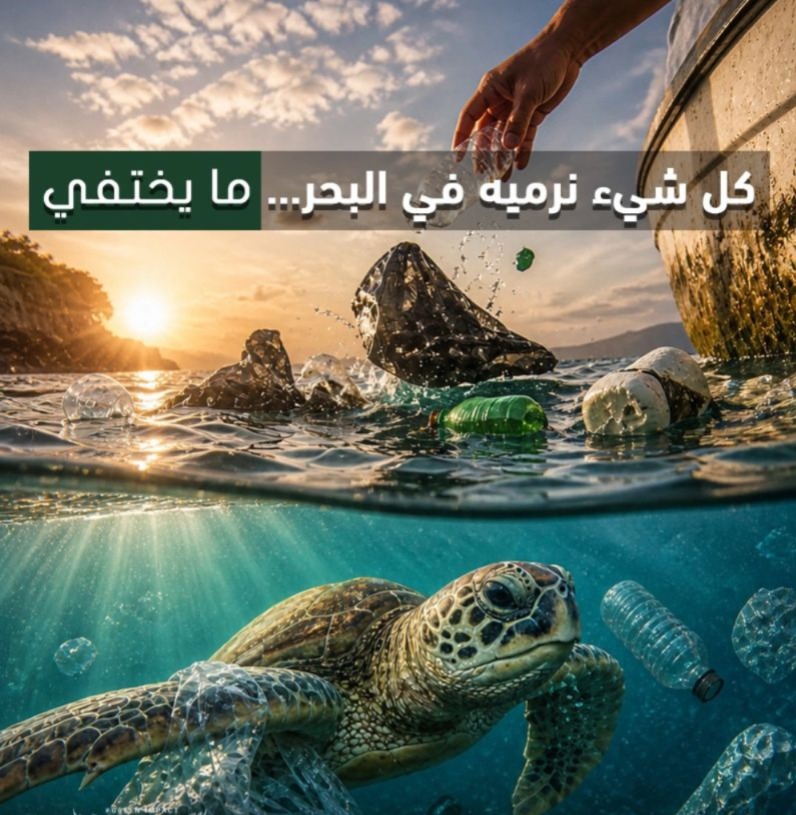
Often, we treat the ocean as a vast, open expanse capable of hiding everything we discard into it. However, the scientific reality is entirely different: waste does not disappear... it transforms.
When waste reaches the marine environment—whether it is plastic, chemical pollutants, or other debris—it does not degrade as we might assume. Plastics, in particular, fragment into microscopic particles known as microplastics. Despite their minuscule size, they pose a severe threat. These particles act as "vectors" for toxic pollutants, absorbing heavy metals and hazardous chemical compounds, which significantly amplifies their detrimental impact on living organisms.
The Food Chain and Human Health
Marine life, ranging from the smallest plankton to apex predators, inadvertently ingests these particles. This triggers a complex chain reaction: these toxins bioaccumulate and biomagnify across the marine food web, ultimately reaching human consumers.
Put simply: what we dump into the ocean inevitably returns to us—only in a altered and far more dangerous form.
Recent studies have detected the presence of microplastics in commercial fish, sea salt, and even drinking water sources. This represents not only an existential threat to marine biodiversity but also a direct hazard to human health and the stability of global ecosystems.
Broad-Scale Ecological and Economic Impacts
The repercussions extend far beyond marine organisms, leading to:
The degradation of biodiversity and disruption of ecological balance.
The destruction of vital marine habitats, such as coral reefs.
Severe economic losses within the fisheries and tourism sectors.
Increased pressure on public health and environmental management systems.
A Call to Action for Environment Week
During Environment Week, the message is clearer than ever: every action has an impact. You are either part of the problem or part of the solution.
Environmental awareness is no longer a luxury; it is an absolute necessity. Reducing waste, embracing recycling, and adopting responsible disposal practices are simple steps—yet they yield a profound difference when transformed into daily habits.
The ocean is not a bottomless pit for our waste; it is a living, breathing ecosystem that reacts to everything we introduce to it.
Ultimately, we must ask ourselves the pivotal question:
Are we prepared to face tomorrow what we choose to discard today?
Be the first to comment!